
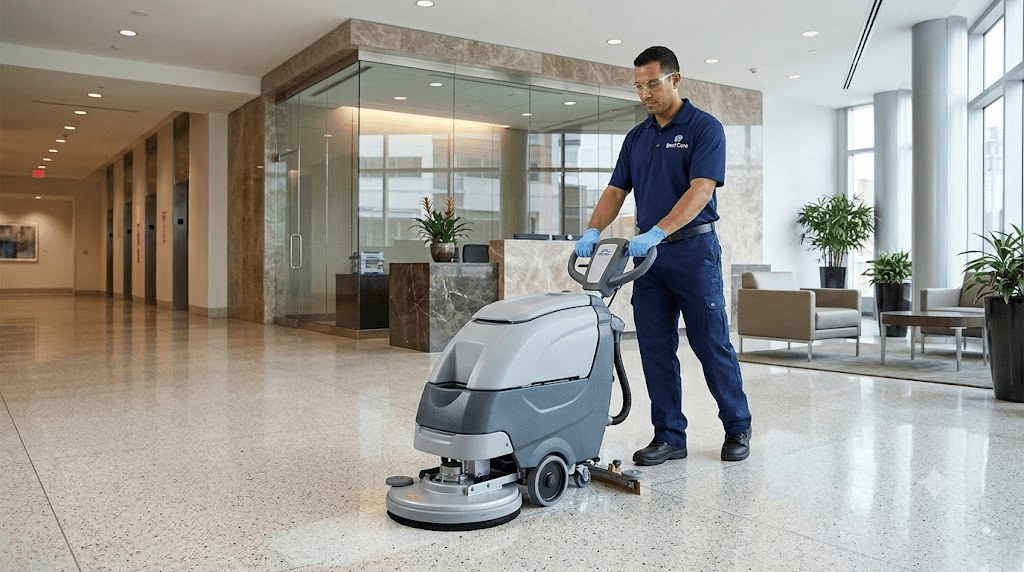
When you manage a commercial property, outsourcing dependable commercial cleaning services isn’t just an expense line item—it’s a core asset preservation and liability management strategy. A subpar cleaning crew doesn’t just leave streaks on windows; they create slip-and-fall risks, compromise indoor air quality, and directly impact employee absenteeism.
1. Commercial vs. Residential Cleaning: The Operational Divide
The word “clean” means entirely different things in a residential setting versus a commercial facility. Understanding these differences prevents costly misunderstandings during vendor negotiations.
| Operational Factor | Residential Cleaning | Commercial Cleaning Services |
| Scale & Equipment | Domestic vacuums, microfiber cloths, retail solutions | Industrial floor buffers, HEPA-filter vacuums, electrostatic sprayers |
| Regulatory Compliance | Minimal (Standard liability insurance) | Strict (OSHA bloodborne pathogen standards, EPA-approved disinfectants, SDS documentation) |
| Scheduling | Business hours (Typically 9 AM – 5 PM) | Off-hours (Nights and weekends to prevent business disruption) |
| Risk Profile | Low foot traffic, low liability | High foot traffic, public liability, secure data environments |
2. Custom Scopes of Work by Facility Type
A medical clinic requires a completely different sanitation level than a distribution warehouse. A top-tier commercial cleaning service should provide a tiered, customized checklist tailored specifically to your sector’s operational footprint.
A. Corporate Offices & Managed Workspace
The focus here is high-touch disinfection, tech-safe dusting, and public-facing presentation.
- Daily: Emptying waste and recycling bins; sanitizing handles, light switches, elevator buttons, and kitchen surfaces; vacuuming traffic lanes; restocking restrooms.
- Weekly: Detailed dusting of vents, baseboards, and window sills; deep cleaning glass entryways; sanitizing communal tech (copiers, conferencing tools).
- Monthly/Quarterly: Carpet extraction cleaning; hard floor burnishing and polishing.
B. Industrial, Logistics & Warehousing
Industrial spaces require heavy-duty grime removal and strict adherence to facility safety lines.
- Key Tasks: High-durability concrete floor scrubbing, grease removal, overhead dust mitigation to prevent fire hazards, and keeping safety floor markings highly visible.
C. Healthcare & Medical Facilities
Medical environments require terminal cleaning practices to mitigate cross-contamination risks.
- Key Tasks: Utilization of hospital-grade, EPA List N disinfectants; strict color-coded microfiber systems to prevent cross-contamination between zones; full compliance with healthcare facility guidelines.
3. The 4 Operational Red Flags to Vet in an RFP
When reviewing bids, the lowest price often carries the highest risk. To protect your company from liability, put every commercial cleaning partner through this rigorous 4-step verification sequence before signing a contract.
1.Verify Insurance and Bond Coverages:Step 1: Liability Defense.
Demand direct proof of General Liability Insurance (minimum $1M/$2M thresholds), Workers’ Compensation for all deployed staff, and a comprehensive Janitorial Bond to protect your physical assets against internal theft.
2.Audit Employee Screening and Security Clearances:Step 2: Security Integration.
Commercial cleaners often access your facility completely unsupervised after hours. Confirm the vendor runs mandatory, third-party criminal background checks and utilizes randomized drug testing for all field staff.
3.Evaluate Chemical & Equipment Standards:Step 3: Regulatory Compliance.
Ensure the provider uses color-coded cleaning protocols to eliminate cross-contamination (e.g., restroom cloths never entering breakrooms). Request their Safety Data Sheet (SDS) management protocol to guarantee OSHA compliance on-site.
4.Analyze Account Management and Quality Audits:Step 4: Accountability Framework.
A great proposal means nothing without consistent execution. Ask: How often do regional supervisors conduct surprise inspections? Look for vendors utilizing digital quality tracking apps that provide photographic proof of completed work directly to your dashboard.
4. Maximizing ROI: Smart Scheduling and Green Cleaning
Optimizing your cleaning schedule can cut unnecessary operational costs by up to 20%.
The Hybrid Scheduling Model: Instead of paying for a full-scale deep clean every night, structure your contract around a “Hybrid Model.” Defer deep floor care, window washing, and high-ceiling dusting to monthly or quarterly rotations, keeping the daily budget focused strictly on heavy foot-traffic areas, restrooms, and trash management.
Additionally, specifying Green Cleaning parameters isn’t just about corporate sustainability. Utilizing green-certified, low-VOC (Volatile Organic Compound) cleaning agents improves daily indoor air quality, which has been directly linked to reducing workplace respiratory irritation and boosting employee focus.